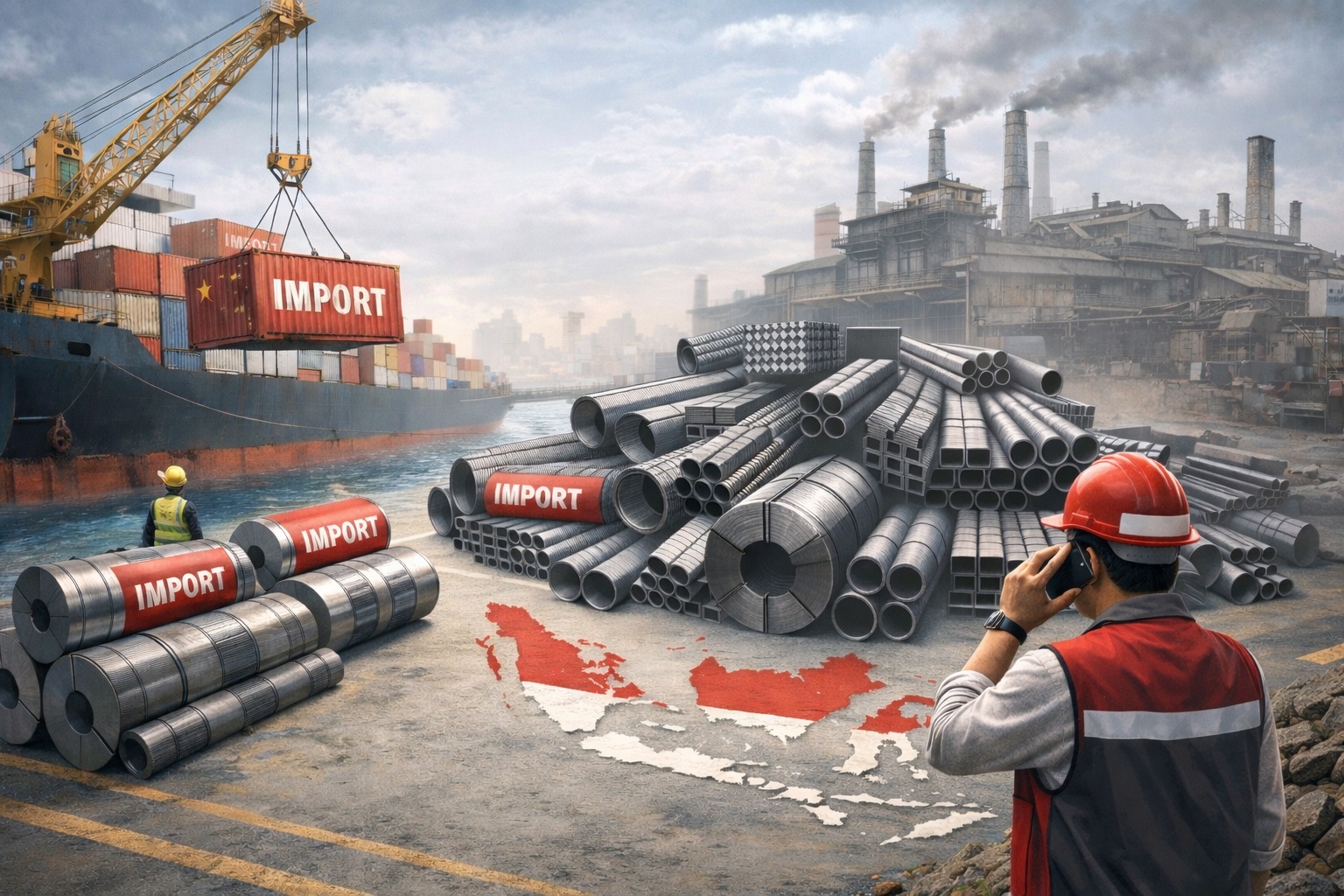
When Cheap Steel Floods the Market: Lessons from India’s Tariff Policy for Indonesia’s Steel Future
At the end of 2025, India took a decisive step: imposing tariffs on select imported steel products to curb the influx of cheap steel.
To some, it seemed like a typical protectionist move. But for industry players, it was a strategic signal about where global steel trade is heading in 2026.
India is not a minor player — it’s one of the world’s largest steel producers and consumers.
When a country of that scale decides to apply the brakes, it signals that something is fundamentally off in the market.
The Global Steel Market Is Out of Balance
The world has faced excess steel production capacity for years.
Mills keep running while demand growth slows, flooding international markets with steel prices that often fail to reflect true production costs.
Competition is no longer about efficiency, but about who can sell cheaper just to keep furnaces running.
Countries without safeguards become easy targets. India read the signals and acted swiftly.
Importantly, India did not shut down imports — tariffs were applied selectively.
The goal was not to stop trade, but to keep it fair.
Cheap Steel: An Underestimated Threat
Cheap steel may seem beneficial because it lowers project costs.
Yet its long-term impact on the industry is severe: shrinking margins, delayed investments, and halted modernization.
Once local capacity is lost, dependency on imports rises — a dangerous cycle for any industrial economy.
That’s why major nations treat steel not as a commodity, but as a strategic industry.
India’s tariff move was not reactionary; it was an act of long-term preservation.
Why It Matters for Indonesia
Indonesia stands at a similar crossroads.
Its steel industry continues to grow as a backbone for construction and manufacturing — yet it remains open to low-cost imports.
With the world in oversupply, Indonesia risks becoming a dumping ground as other countries tighten trade rules.
If unmanaged, price pressure could quietly erode domestic competitiveness.
The key question isn’t whether Indonesia should copy India’s tariffs, but rather:
How can Indonesia protect its steel industry without disrupting trade and downstream sectors?
Protection Isn’t Always About Tariffs
Tariffs are visible tools, but not the only ones.
Many nations are now focusing on flow management — regulating when, how much, and how fast steel enters their markets.
Often, the problem isn’t lack of supply but bad timing.
Large imports during weak demand periods trigger unnecessary price wars.
That’s where system-based and logistics-based solutions come in.
Smarter Steel Flow Management
Facilities like Bonded Logistics Centers (PLB) give importers the flexibility to manage inventory without immediate customs and tax pressure.
Steel can be stored, released when demand rebounds, or even re-exported if necessary.
PLBs are not protectionist tools — they are trade risk management systems that help markets stay disciplined and adaptive amid global volatility.
India’s Key Lesson
India’s tariffs teach an essential lesson:
When the global market becomes distorted, governments and industries must think strategically, not reactively.
The goal is to maintain fair trade — not close it off.
For Indonesia, the steel sector’s future depends not just on price, but on how intelligently trade flows are managed.
TCI’s Perspective
In times of policy change and market volatility, managing imports, inventory, and trade flows is more critical than ever.
Transcon Indonesia believes that proactive dialogue and thoughtful planning empower industries to make resilient, data-driven decisions.
We welcome discussions on how logistics management and bonded facilities can support your business strategies amid shifting global dynamics.